How to Select the Best Overhead Crane for Your Industrial Needs?
Overhead cranes play an essential role in today's industry. They help a lot in areas like manufacturing, warehousing, steel production, and tough jobs. For business owners, engineers, or procurement managers, key questions often come up. These include: which crane gives better value, which allows for greater lifting height, and which handles ongoing heavy work best?
As a global supplier of double-girder overhead cranes for wholesale, FLAGCRANE offers custom crane designs for many industries worldwide. The solutions come with proven quality and skilled engineering support.
What Is a Single Girder Overhead Crane?
Single Girder Overhead Crane Design
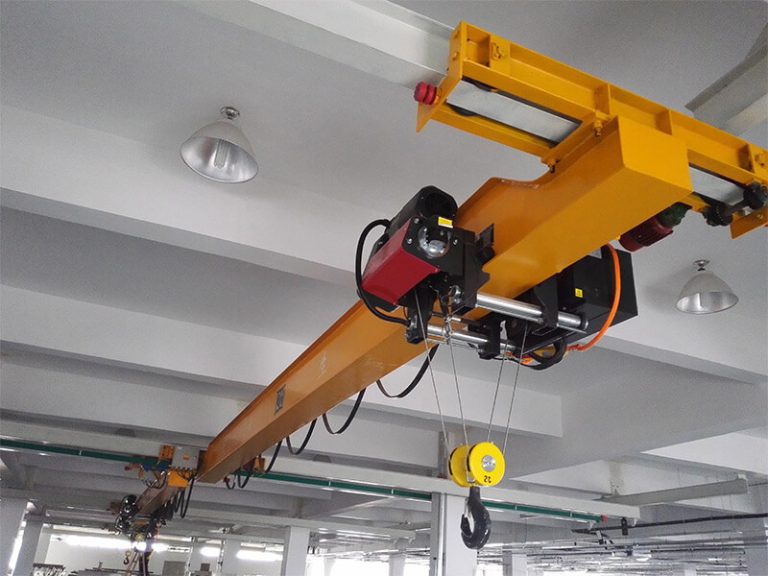
The single girder overhead crane setup uses one primary girder beam. It holds a hoist that runs right below it. This setup keeps things small and light. It works well in places with tight headroom or limited building strength.
Technical Specifications of Single Girder Overhead Cranes
lLifting Capacity: 1t–32t
lSpan Length: 7.5m–28.5m
lLifting Height: 6m–30m
lWorking Class: A3, A4
lAmbient Temperature: -20℃ to 40℃
These details suit single girder cranes for basic to moderate lifting tasks. However, they do not fit well for steady or intense work.
Applications of Single Girder Overhead Crane
Common uses include:
- Warehouses
- Assembly lines
- Light manufacturing facilities
- Equipment maintenance bays
Advantages of Single Girder Overhead Cranes
- Lower purchase and installation costs
- Faster setup and commissioning
- Reduced structural load on buildings
- Energy-efficient operation
- Simple maintenance routines
Limitations of Single Girder Overhead Crane
- Lifting height is limited due to the under-running hoist design
- Load capacity typically does not exceed 32 tons
- Not suitable for high-frequency or heavy-duty usage
- Limited potential for system upgrades
What Are Double Girder Overhead Cranes?
Double Girder Overhead Crane Design
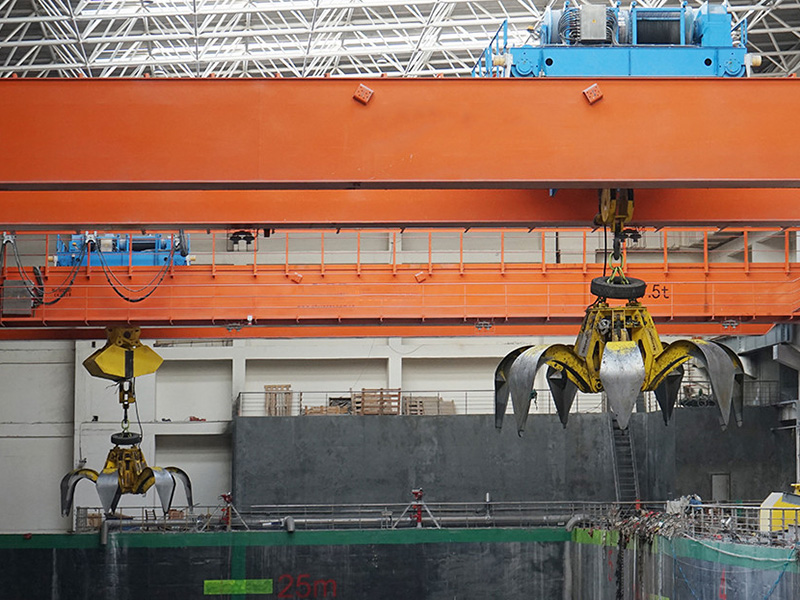
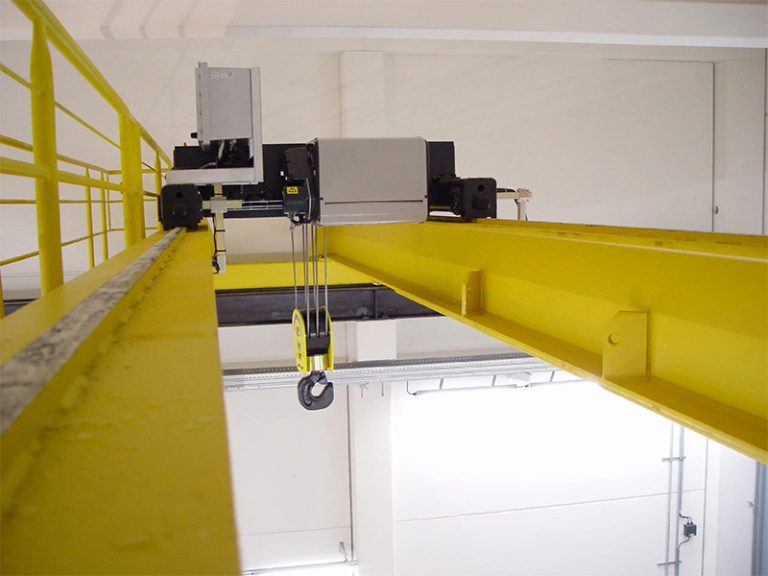
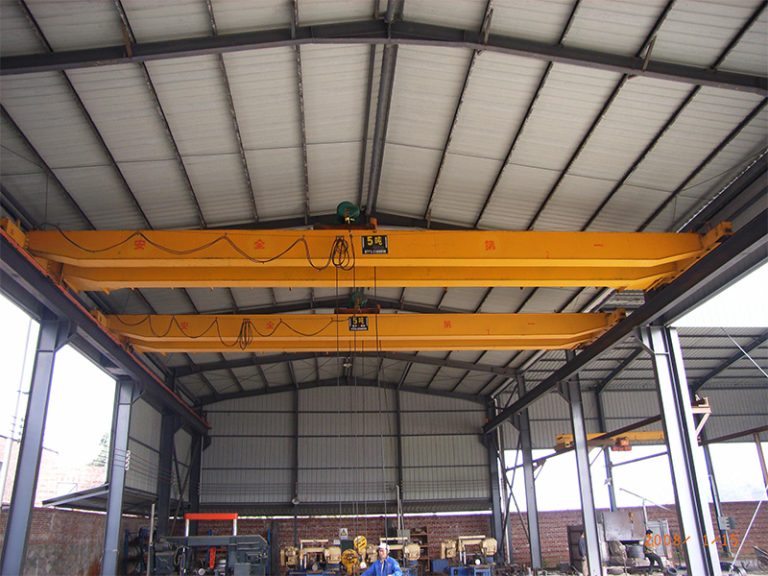
Double girder overhead cranes feature a pair of parallel girders. The hoist rests atop the bridge beams. Such a design enhances durability and stability. This arrangement works well in harsh industrial environments.
Technical Specifications of Double Girder Overhead Cranes
lLifting Capacity: 5t to 800t
lSpan: 7.5m to 35m
lLifting Height: 6m to 30m
lWorking Class: A5, A6, A7, A8
lAmbient Temperature: -20℃ to 50℃
These specs fit double girder cranes for big and challenging tasks.
Applications of Double Girder Overhead Cranes
- Steel production facilities
- Power generation plants
- Shipbuilding yards
- Heavy machinery assembly lines
- Continuous production environments
Advantages of Double Girder Overhead Cranes
- Capable of super heavy lifting up to 800 tons
- Maximum hook height due to top-running hoist design
- High structural rigidity and fatigue resistance
- Can accommodate auxiliary hoists and automation systems
- Built for long-term industrial performance
Limitations of Double Girder Overhead Cranes
- Higher initial capital investment
- Requires a stronger building structure or foundation
- Maintenance and spare parts can be costlier over time
Single Girder vs Double Girder Overhead Cranes – Which Is Better? (Comparison Table)
| Feature | Single Girder Overhead Crane | Double Girder Overhead Cranes |
| Girders | One main girder | Two main girders |
| Lifting Capacity | Up to 32 tons | Up to 800 tons |
| Span | Up to 28.5 meters | Up to 35 meters |
| Lifting Height | Limited | Maximum |
| Working Class | A3–A4 | A5–A8 |
| Installation Cost | Lower | Higher |
| Suitable Industries | Light-duty warehousing & assembly | Heavy-duty manufacturing & steel plants |
| Automation Compatibility | Limited | High |
How to Choose Between a Single Girder and a Double Girder Overhead Crane?
Choose a Single Girder Overhead Crane If:
- Required lifting capacity is 20 tons or less
- Facility has height or space limitations
- Budget is limited, or ROI must be quick
- Operations involve light to medium duty cycles
Choose Double Girder Overhead Cranes If:
- Load requirement is above 25 tons
- Maximum lifting height is critical
- Operation requires high frequency or durability
- Used in steel, power, and shipbuilding industries
- Future expansion or automation is planned
Cost vs Performance – Which Is More Cost-Effective?
The single girder model offers a budget-friendly option for brief or easy tasks. It has a smaller upfront cost and faster payback. Yet, for ongoing factory projects, double girder overhead cranes prove more economical in the end. Their toughness, better lifting power, and options for future changes make the difference.
Why Choose FLAGCRANE as Your Wholesale Double Girder Overhead Cranes Supplier?
FLAGCRANE is a skilled group company. We handle crane design, manufacturing, sales, installation, after-sales, and upkeep. The company sits in Changyuan Crane Industrial Park, Henan Province. With more than 30 years in crane design, building, delivery, and setup for global uses, FLAGCRANE brings practical solutions. These include:
- Certified quality (ISO / CE / SGS / SABER)
- Customized solution support, including non-standard models like 800T gantry crane or 360T overhead crane
- Factory-direct pricing without intermediaries
- Export experience to over 50 countries, including the USA, Germany, Brazil
- Comprehensive services: from engineering design to 24/7 after-sales support
What Information Do You Need for Overhead Crane Design?
To give the best solution, share these details:
- Required lifting capacity (tons)
- Span (meters)
- Lifting height (meters)
- Workshop dimensions and layout
- Industry application type
- Expected working duty/classification (A3–A8)
- Power supply specifications
Each item affects the crane's build, parts choice, and total price.
Conclusion
The single girder overhead crane operates as an economical solution for basic lifting operations in warehouse environments and small commercial facilities. The double girder overhead crane operates best for handling heavyweight materials. The equipment operates continuously in steel manufacturing facilities and manufacturing production areas. The selection process for equipment involves evaluating five essential factors which include operational height, weight capacity, speed requirements, financial constraints and potential business expansion needs.
FAQ
Q: What is the maximum lifting capacity of double-girder overhead cranes?
A: The double girder overhead cranes handle up to 800 tons. The specific amount depends on the particular design needs.
Q: Can a single girder overhead crane be upgraded later?
A: It has limited upgrade possibilities. In cases of planned expansion or automation needs, the double girder configuration is more suitable.
Q: What's the difference between the single and double-girder cranes' hoist positions?
A: The hoist travels below the beam in single-girder cranes; for the double-girder setups, the hoist travels along rails atop the girders. This design provides higher lifting clearance.
Q: Are double girder overhead cranes compatible with automation?
A: Yes, they do show up in automated material handling systems. Some cranes will include additional hoists and sensors.
Q: What are the relevant international certifications that guarantee crane safety and quality?
A: ISO, CE, SGS, and SABER are some of the certificates that prove compliance with global safety and quality laws. FLAGCRANE’s machines meet them all.