1. Introduction

Gantry cranes are powerful lifting equipment designed to move heavy loads with precision and efficiency. Unlike overhead cranes that rely on building structures for support, gantry cranes operate on freestanding legs that run on rails or wheels. This independent structure makes them especially suitable for outdoor environments. They offer high flexibility, easy mobility, and the ability to handle various materials across open areas such as ports, construction sites, and industrial yards.
One of the key advantages of gantry cranes is their adaptability to different operational needs without requiring permanent installation. They can be configured with varying load capacities, spans, and lifting heights depending on specific project requirements. As a result, gantry cranes are widely used in industries such as shipping, construction, manufacturing, rail transportation, and shipbuilding, where durability and versatility are essential.
2. Port and Shipping Industry Applications
In the port and shipping field, gantry cranes hold a key role in container work. They load and unload containers from ships quickly and correctly. These cranes cover several rows of containers. And they raise heavy loads well over big spaces. The build lets workers shift containers right from ships to storage areas or trucks.
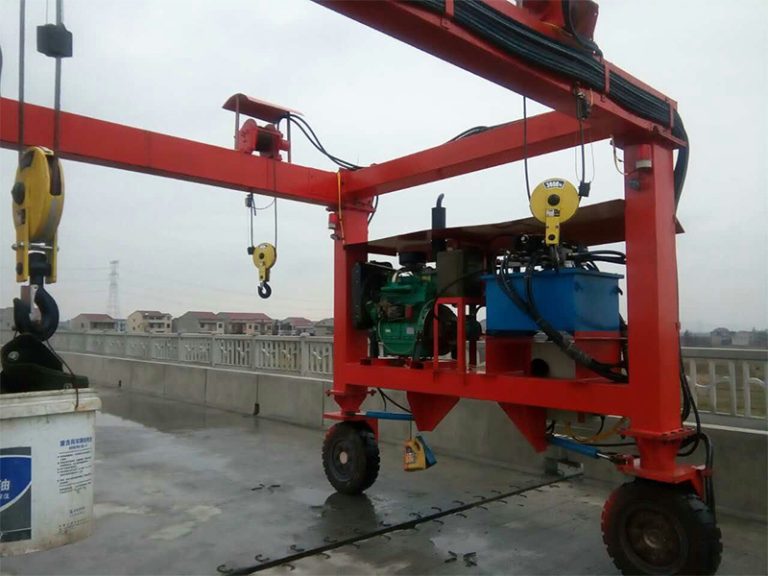
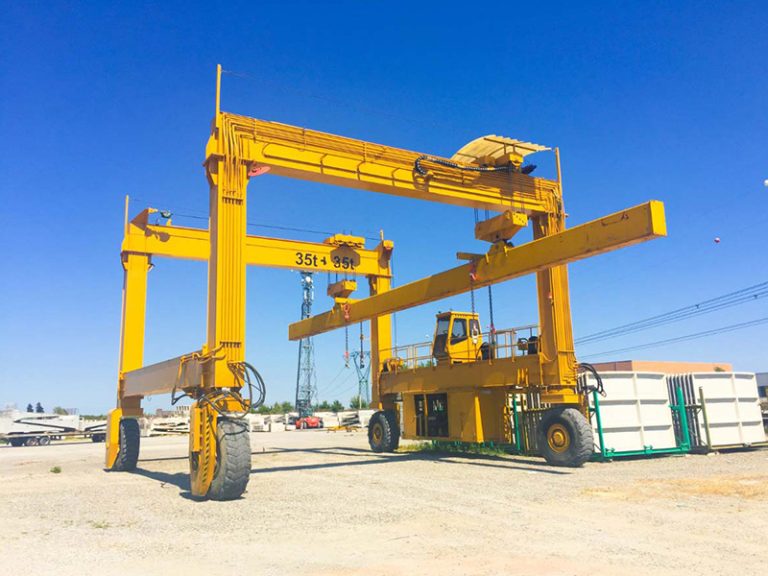
Yard tasks gain a lot from gantry cranes. This comes from their power to stack containers high and make the best use of storage room. Rubber-tired gantry (RTG) cranes often work in container yards. They move well on rough ground. Rail-mounted gantry (RMG) cranes suit terminals better. There, an exact match with rail paths helps for shifts between transport modes.
FLAGCRANE owns over 1000 sets of processing and testing tools, such as a large floor boring machine, a CNC cutting machine, a steel plate leveling machine, automatic welding equipment, a shot blasting machine, and an X-ray flaw detector. This strong-making skill guarantees solid work from FLAGCRANE port gantry systems. Load limits go from 5t to 800t. Spans reach up to 35m. These fit large sea transport needs.
3. Construction Industry Applications
In the building area, gantry cranes prove vital for dealing with ready-made concrete parts like beams, slabs, and bridge pieces. Their skill to raise heavy items safely marks them as key in big projects such as bridges and tunnels. Building sites often need bending lifting aids that fit changing plans. Mobile gantry cranes give this bend without fixed bases.
For bridge-building jobs, double girder gantry cranes supply the power needed to raise huge beams into spots with fine exactness. On-site item handling gets smoother, too. This happens when workers use smaller movable gantries to shift steel rods or form parts in tight spots.
FLAGCRANE can offer a wide range of lifting and handling systems to match all lifting requirements – from heavy-duty processes to clean-room applications and harsh environment lifting equipment. The company’s tailored models include options like a 320t double girder system with a span of up to 35m—perfectly suited for demanding construction environments where reliability is essential.
4. Manufacturing and Industrial Yard Applications
In making plants and factory yards, gantry cranes smooth the flow of materials. They do this by aiding good outdoor handling between making zones or storage spots. These cranes help move large machine pieces or basic supplies that lifts alone cannot carry.
During gear setup steps—mainly in tough fields like steel making or wind power building—gantry cranes make sure of right placement of big parts in fitting or joining work. They also boost safety. This occurs by cutting risks from handwork on large items.
FLAGCRANE is a professional group company integrating crane design, manufacturing, sales, installation, after-sales, and maintenance. FLAGCRANE’s range includes models with working classes A5–A8, suitable for continuous industrial use under high-duty conditions. With lifting heights to 30m and ambient temperature tolerance from -20°C to 50°C, these systems perform reliably even in harsh outdoor environments.
5. Rail Yard and Logistics Applications
Rail stops depend much on gantry cranes for moving containers between trains and trucks. This process is called intermodal work. Rail-mounted gantries give exact travel along paths. At the same time, they keep steady during big raises. This cuts wait times at cargo yards. It does so by lessening manual labor in load shifts.
Cargo work in transport hubs also gains from movable rubber-tired types. These can cross many paths without set rails. Such systems let workers manage varied cargo kinds—from usual containers to extra-large goods—with little stop time.
FLAGCRANE designs both RMGs and RTGs tailored for rail logistics sectors worldwide. Our products have been exported to more than 50 countries, including the USA, Germany, Brazil, Chile, Lithuania, Spain, Italy, Belgium, Poland, etc., widely used in the paper-making industry, mining industry, steel industry, railway etc. Such global experience ensures every FLAGCRANE system meets international standards like ISO and CE certifications.
6. Shipyards and Heavy Engineering Applications
Shipyards count on huge gantry cranes that can raise whole ship parts during build steps or do upkeep on boats in fix. These cranes must manage very heavy loads. And they need to keep building strength over long reaches.
Large build parts raising—such as ship body blocks or drive units—call for double girder setups made for top steady under moving states. Upkeep tasks gain from smaller helper gantries. These aid in part swaps or refit jobs.
We have more than 30 years of experience in crane design, fabrication, delivery, and installation for all applications globally. FLAGCRANE’s heavy-duty models, like the 800T double girder system, are engineered specifically for shipbuilding environments where precision alignment is critical during vessel assembly.
7. How to Choose the Right Gantry Crane
Selecting an appropriate gantry crane involves evaluating several key parameters:
Load capacity: Determine the maximum weight requirement based on operational needs; FLAGCRANE offers capacities ranging from small portable units (0.5t) up to ultra-heavy-duty versions (800t).
Span & lifting height: Choose suitable dimensions depending on workspace layout; typical spans range from 7.5m to 35m with lifting heights to 30m for large-scale applications.
Mobility: Decide between rail-mounted systems offering precision alignment or rubber-tired variants providing flexible movement across open yards.
Working environment: Consider ambient conditions; Ambient Temperature: -20℃ to 50℃ ensures reliable operation even under extreme weather situations.
FLAGCRANE’s engineering team provides full customization support—from design through installation—to ensure each solution perfectly matches client requirements while complying with safety standards.
8. Conclusion
Gantry cranes act as vital aids across fields, including ports, building sites, factories, rail stops, and shipyards. Their power and fit help handle varied loads well outdoors without building support needs. Picking the right type boosts output. It also ensures safe item flow in any task.
FLAGCRANE brings full answers backed by years of skill in building new ideas and world service reaching over fifty lands. Businesses looking for lasting overhead crane setups or custom gantry aids can reach FLAGCRANE now for skilled advice or ask for a full quote fit to project details.
FAQ
Q: What is the main difference between an overhead crane and a gantry crane?
A: An overhead crane relies on building structures like beams or columns for support, whereas a gantry crane stands independently on legs running along rails or wheels.
Q: What industries most commonly use FLAGCRANE’s gantry systems?
A: Industries such as ports & shipping terminals, construction projects, manufacturing plants, rail logistics centers, shipyards, and steel fabrication facilities frequently use these systems.
Q: Can FLAGCRANE customize a crane based on special project requirements?
A: Yes. FLAGCRANE can offer a wide range of lifting and handling systems to match all lifting requirements – from heavy-duty processes to clean-room applications.
Q: What certifications do FLAGCRANE products hold?
A: FLAGCRANE's equipment has passed ISO, CE, SGS, SABER, and other domestic and foreign professional certifications.
Q: Does FLAGCRANE provide after-sales service globally?
A: Our professional service team is dedicated to ensuring an operative crane in your worksite and is always ready to provide 24/7 after-sales services.