A factory crane should not be selected based on capacity alone. The correct design begins with the material, travel route, building, and lifting frequency.
This guide shows how plant conditions become technical specifications before manufacturing and installation.
1. Start With the Manufacturing Process, Not the Crane Type
Map the Load, Travel Path, and Lifting Frequency
First describe the actual job. Record the heaviest and normal loads, dimensions, center of gravity, lifting points, and any difficult handling characteristics.
Then map where the load starts and stops. Does it move across one workstation, one bay, or the entire workshop? A crane used for occasional pump maintenance has a different operating pattern from one feeding a production line.
Also record lifts per hour, shift length, starts and stops, and how often loads approach rated capacity. These factors affect duty class, motors, brakes, wheel loads, and component life. For assembly, define positioning tolerance and slow approach speed.
New Factory vs. Existing Building: Define Structural Constraints
In a new plant, the runway, columns, roof, foundations, and production layout can be designed together. This offers more freedom to optimize hook coverage and headroom.
An existing building needs a structural survey. Engineers should verify columns, runway beams, brackets, rails, foundations, and allowable wheel loads, while locating roof trusses, lights, ducts, pipes, machines, and doors that could restrict movement.
Installation access is equally important. We need to know how girders will enter the bay, where they can be assembled, and whether production can stop during installation.
2. Confirm the Core Factory Crane Specifications
Capacity, Load Shape, and Below-the-Hook Device
Rated capacity must include the workpiece and the lifting attachment. Add the weight of any lifting beam, C-hook, tong, grab, electromagnet, rotating device, or special hook.
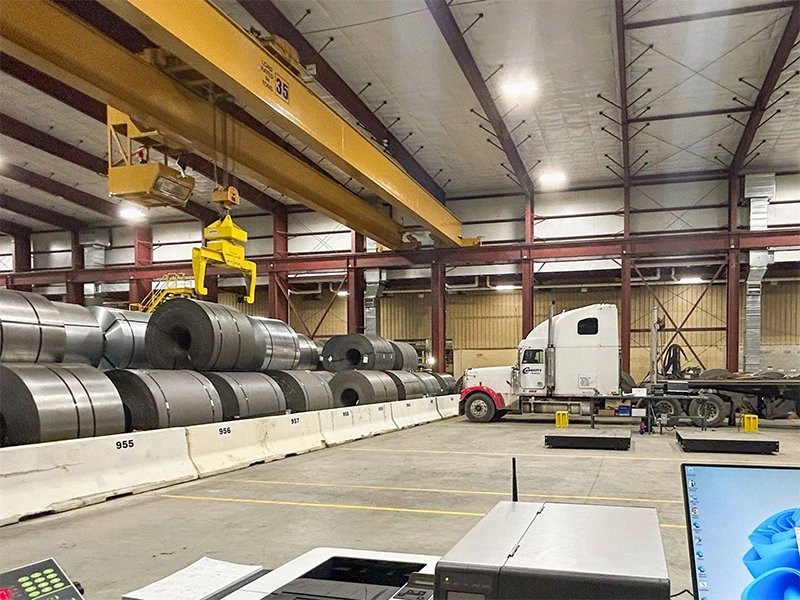
Load geometry also affects the solution. A long machine bed may need a lifting beam, steel coils may require a C-hook or tong, and uneven equipment may need adjustable lifting points. Some maintenance projects also need main and auxiliary hooks.
A reasonable future margin may be useful, but excessive oversizing increases deadweight, wheel loads, structural cost, and energy use.
Span, Runway Length, Lifting Height, and Headroom
| Plant information | Crane specification affected |
| Distance between runway supports | Crane span |
| Length of the production bay | Runway travel length |
| Required hook position | Lifting height |
| Roof and obstruction clearance | Headroom and crane arrangement |
Span is based on runway geometry, not simply total building width. Lifting height should cover the distance from the lowest pickup point to the highest hook position needed to clear equipment.
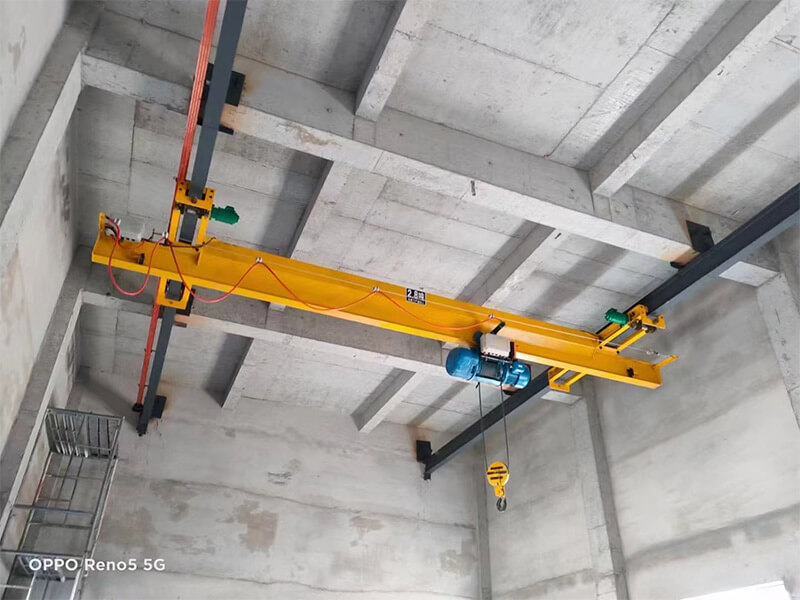
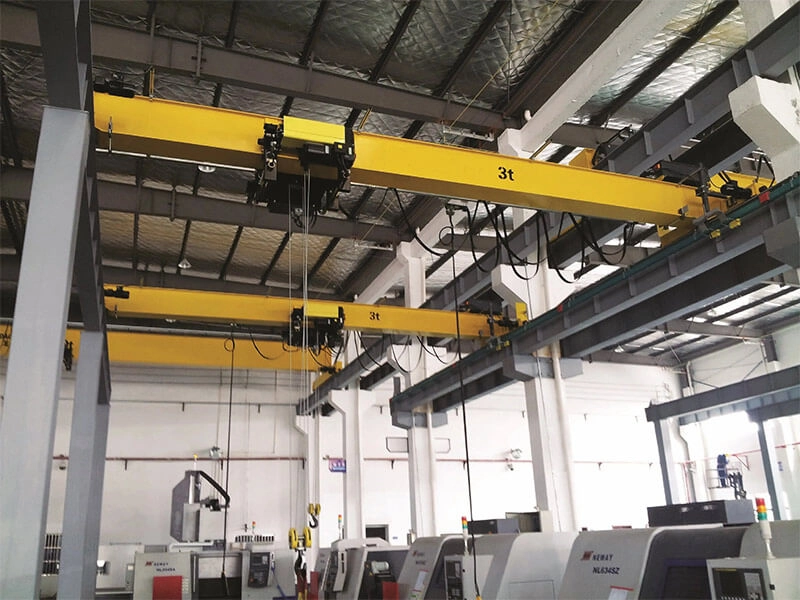
Headroom matters in low buildings. FLAGCRANE’s HD European single-girder overhead crane uses an ND European electric hoist and a compact drive arrangement. Published parameters include capacities up to 20 t, spans from 7.5 to 28.5 m, inverter-controlled travel, and FEM 2M/ISO M5 duty. Its lightweight design can reduce loads on supporting structures.
Duty Class, Travel Speed, and Positioning Accuracy
Capacity tells us what the crane can lift; duty tells us how intensively it works. Maintenance and production cranes can have very different operating patterns.
Speed should support the process. Long travel paths may justify faster bridge movement, while final placement may require micro-speed. Variable-frequency control provides smooth acceleration and deceleration and can improve positioning.
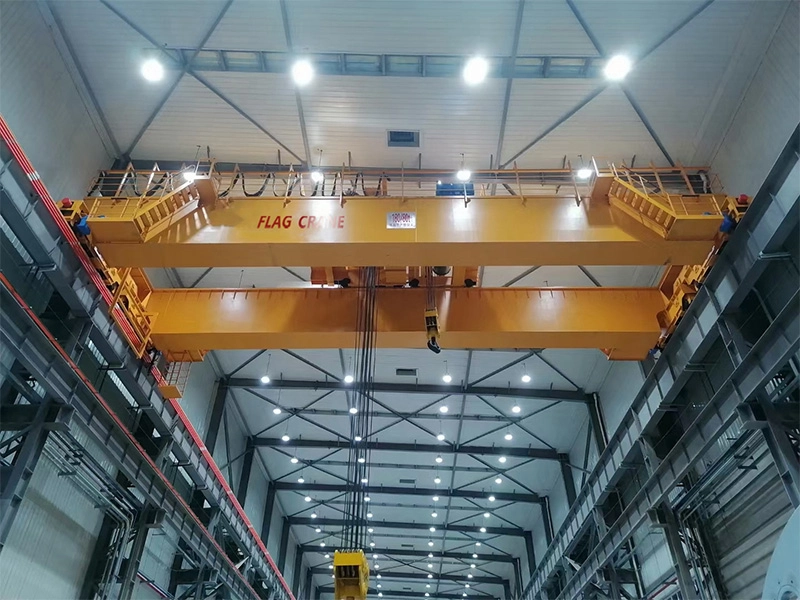
For precision assembly, useful options may include dual-speed or stepless control, anti-sway functions, automatic positioning, and restricted operating zones. QDX double girder cranes can be configured with frequency-converted motions, anti-sway devices, automatic positioning, and monitoring or remote diagnostic options.
3. Match the Crane System to the Facility and Work Environment
Overhead, Gantry, Jib, or Workstation Crane: A Decision Matrix
| System | Best fit | Main design question |
| Overhead crane | Full-bay coverage | Can the runway structure carry the loads? |
| Gantry crane | Areas without elevated runway support | Is ground space clear for legs and rails? |
| Jib crane | One machine or maintenance station | What outreach, rotation, and foundation are needed? |
| Workstation crane | Repetitive light handling | Is ergonomic movement the priority? |
An overhead crane keeps floor space relatively clear. A gantry crane transfers bridge loads through legs to ground-level rails. The MH single-girder gantry crane is a rail-operated medium- and light-duty design with a published capacity range of 1–32 t and A3/A4 working class. It can use a wire-rope or chain hoist and includes limit, overload, emergency-stop, and voltage protection.
Jib and workstation systems suit localized work, but reach, cycle time, operator effort, and future layout changes still matter.
High Heat, Dust, Outdoor Exposure, Precision Assembly, and Maintenance Conditions
The environment affects motors, brakes, electrical protection, paint, lubrication, controls, and attachments.
Steelmaking areas may involve heat, dust, frequent starts, billets, coils, or specialized tools. FLAGCRANE provides metallurgical configurations for ladle, billet, ingot, roll, and coil handling, with options such as lifting beams, electromagnets, C-hooks, and tongs.
Outdoor equipment requires consideration of rain, corrosion, temperature, and wind. Precision assembly benefits from smooth motion and low sway. Power and water facilities often prioritize access to pumps, generators, valves, or other major components over continuous high-speed production.
4. Factory Crane Project Examples
General Manufacturing: Serbia HD10t and Cameroon MH16t Projects
For an engineering project in Serbia, FLAGCRANE supplied two HD10t-17.3m single-girder overhead cranes. In Cameroon, an MH16t-10.22m single girder gantry crane was supplied for plastic product manufacturing. The projects illustrate two structural approaches: elevated runway travel and a bridge supported by gantry legs.
Power Generation: Ivory Coast QDX95/10t Project
For a power generation project in Ivory Coast, FLAGCRANE supplied a QDX95/10t-18.635m double-girder overhead crane. The main and auxiliary capacities support handling tasks involving components of different weights. The QDX range covers 5–320 t, spans of 7.5–35 m, lifting heights of 6–30 m, and A5–A8 duty classes.
5. Pre-Quotation and Installation Checklist
The 9 Data Points and Drawings to Send Your Crane Supplier
Send these details before requesting a final configuration:
- Maximum and normal operating loads
- Load dimensions, shape, center of gravity, and lifting points
- Required span
- Required lifting height and available headroom
- Runway or crane travel length
- Lifts per hour, shifts, operating hours, and load spectrum
- Indoor or outdoor conditions, including heat, dust, moisture, or hazards
- Power supply, control method, speed, and positioning requirements
- Factory drawings, runway details, site photos, and new or existing building status
At FLAGCRANE, we use this information to review the working envelope, duty, controls, attachments, and installation constraints. Accurate input reduces revisions and helps the equipment fit the real process.
FAQ
Q: What information is required for factory crane design?
A: We need load data, dimensions, lifting points, span, lifting height, runway length, operating frequency, environment, power supply, controls, and the factory layout. We also need to know whether the project is for a new or existing building.
Q: How do I choose the correct factory crane capacity and duty class?
A: Add the workpiece and lifting attachment weights, then evaluate lifts per hour, operating time, starts, stops, and the share of lifts near rated capacity. Capacity and duty class must be selected together.
Q: Can a factory crane be installed in an existing building?
A: Yes, after checking the columns, runway beams, foundations, roof clearance, installation access, and allowable wheel loads. Some facilities may require structural reinforcement.
Q: What is the difference between a factory overhead crane and a factory gantry crane?
A: An overhead crane travels on elevated runways. A gantry crane carries its bridge on legs that travel at ground level. The choice depends on structural support, floor clearance, coverage, and the operating environment.
Q: Which factory crane is recommended for high-precision assembly?
A: A workstation or jib crane can suit localized light handling. Larger areas or heavier parts may require a variable-frequency overhead crane. Consider micro-speed, sway control, positioning tolerance, capacity, and cycle frequency.