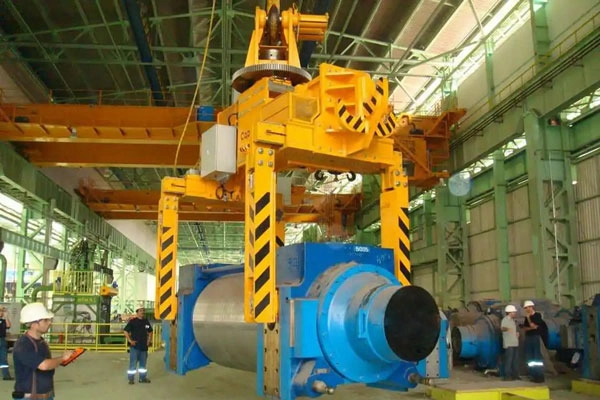
Moving a steel coil is more than a lifting task. The cylindrical load is difficult to align and vulnerable to edge or surface damage. The lifting device must also match the crane, production rhythm, storage layout, and coil orientation.
Motorized coil tongs improve this process by combining powered gripping with controlled crane movement.
Where Steel Coil Handling Loses Safety and Productivity
Manual Engagement Places Workers Close to Suspended Coils
Conventional handling may require an operator to guide the attachment and release it near the coil. This places people close to the hook and suspended-load path, especially where storage is tight or visibility is limited.
A powered gripping mechanism lets the operator open and close the tongs from a controlled position. Remote control can further reduce unnecessary manual contact. It supports, rather than replaces, inspections, exclusion zones, and operator training.
Slow Alignment and Uncontrolled Contact Increase Cycle Time and Coil Damage
A coil may require several corrections before the lifter is centered. Each adds crane travel and waiting time, while poor alignment can tilt the load or press against an edge.
Finished and cold-rolled coils may suffer scratches, pressure marks, or edge deformation. Hot-rolled material creates different concerns, including scale, heat, dust, and frequent heavy-duty service. The lifting solution must secure the coil while limiting impact. Protective pads, balanced geometry, gripping range, and controlled movement should match the material.
How Motorized Coil Tongs Improve the Handling Cycle
Remote Powered Gripping Reduces Manual Intervention
A normal operating sequence includes:
- Position the open tong above the coil.
- Lower it to the engagement point.
- Close the arms under operator control.
- Confirm stable contact.
- Lift and transfer the load.
- Place the coil at its destination.
- Release the arms and clear the area.
Electric opening and closing eliminate manual actuation of the tong at the load and can reduce close-range manual intervention, provided that the tong is correctly positioned and engagement is positively confirmed. FLAGCRANE can also configure remote operation and light-and-sound warning indicators.
Synchronized Arms and Limit Controls Improve Symmetrical Engagement
A coil tong generally includes a suspension beam, connection components, an opening-and-closing mechanism, synchronizing parts, clamping arms, supports, and load-contact elements. These parts must move together so that the arms approach the coil symmetrically and the load remains stable after the tong has been correctly positioned.
Opening and closing limits, anti-tightening measures, stops, and load confirmation should be defined during engineering, especially when one device handles several widths.
| Handling issue | Design response | Operational effect |
| Uneven arm movement | Synchronized arms | More symmetrical engagement |
| Excessive pressure | Controlled closing and stops | Lower local damage risk |
| Load movement | Balanced suspension | More stable travel |
| Limited visibility | Remote control and alarms | Better operator awareness |
Controlled Release Speeds Up Transfers Between Storage and Production
Release is part of the production cycle. At a slitting line, stamping line, or storage saddle, the coil must be positioned before the arms open. Controlled release helps prevent sudden movement and reduces repeated repositioning.
Where orientation must change, powered rotation can be considered. Cable supply may use a spiral cable or cable reel according to travel, height, rotation, and power.
Which Steel Mill Applications Benefit Most
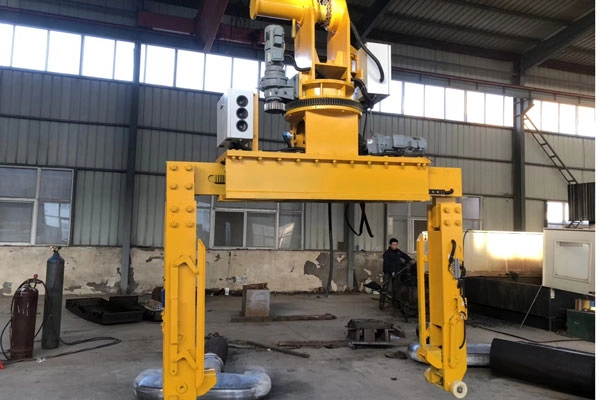
Hot-Rolled Coil Storage and Transfer
Hot-rolled coil areas combine heavy loads, dust, scale, frequent crane movements, and variable temperatures. The equipment must be specified for actual ambient and load conditions, not capacity alone.
The review should cover duty cycle, contact materials, lubrication, electrical protection, and inspection access. FLAGCRANE supplies heavy-duty overhead crane systems that can be equipped with coil tongs and other special attachments for steel-industry operations.
Cold-Rolled and Finished Coil Handling
Cold-rolled, coated, or finished coils require closer control of the contact area. Protective pads may reduce scratching, but their material, shape, attachment, and replacement interval must match the surface and environment.
The design should avoid concentrated pressure and vulnerable edges while accounting for width, outer diameter, inner diameter, weight, and storage position. A wide operating range is useful only when the tong remains stable across that range.
Slitting, Stamping, and Production-Line Feeding
Line feeding involves frequent transfers, so small delays accumulate. Predictable engagement, controlled placement, and equipment compatibility matter more than maximum speed alone.
Consider a typical cold-rolled coil area feeding a slitting line. The crane has adequate capacity, but operators spend time guiding a basic attachment and correcting coil position. A customized powered tong could standardize the sequence and reduce manual engagement. Before estimating benefits, engineers must confirm the total suspended load, hook interface, headroom, coil range, control method, and line-side clearance.
What to Check Before Integrating a Motorized Coil Tong with an Overhead Crane
Confirm Coil Weight, Width, ID, OD, and Eye Orientation
Start with the complete load envelope:
- Minimum and maximum coil weight
- Minimum and maximum width
- Inner and outer diameter
- Horizontal or vertical eye orientation
- Surface condition and temperature
- Storage saddle and destination geometry
FLAGCRANE uses load weight, dimensions, crane capacity, intended purpose, and working conditions as basic inputs for a customized crane solution.
Check Crane Capacity, Headroom, Duty Cycle, and Hook Connection
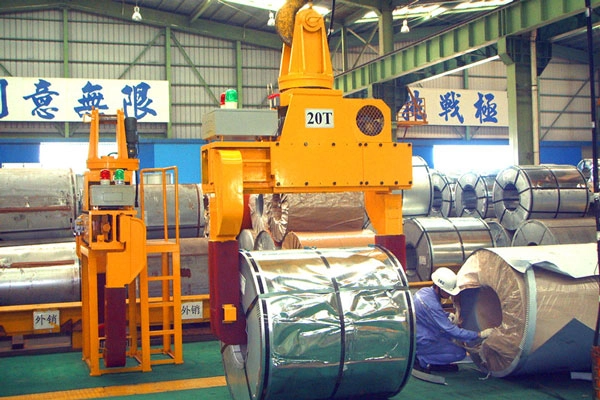
The rated capacity of the crane and hoist must be sufficient for the total superimposed load on the hook, including the coil, the coil tong, and any other below-the-hook accessories. Headroom determines whether the complete assembly can clear storage structures, machinery, and the building.
The review should also cover crane classification, lifting frequency, speeds, hook dimensions, anti-rotation needs, and the connection arrangement. A double-girder crane may suit demanding steel-mill service, while lighter applications may use another configuration. Final selection requires engineering calculations and site data.
Define Power Supply, Controls, Rotation, and Safety Functions
Before manufacturing, agree on the functional specification:
| Item | Decision required |
| Power | Voltage, frequency, phases, supply route |
| Control | Pendant, remote, cab, or system interface |
| Cable management | Spiral cable or cable reel |
| Motion | Open/close only or with rotation |
| Feedback | Limits, alarms, and status indication |
| Protection | Contact pads and environmental protection |
| Parking | Storage platform when required |
This avoids a common problem: a mechanically suitable tong that does not match the crane’s electrical or operating system.
How to Evaluate the Operational Payback
Payback should be measured with plant data, not a general percentage. Establish a baseline before installation and compare:
- Time from crane arrival to secure lift
- Total transfer time per coil
- Number of ground personnel involved
- Repositioning attempts per cycle
- Surface or edge damage events
- Maintenance hours and unplanned downtime
- Coils moved per shift
A successful project creates a repeatable process that fits production, protects the material, and remains practical to inspect and maintain.
FAQ
Q: What are motorized coil tongs used for in steel mills?
A: They grip, lift, transfer, position, and release steel coils between storage areas and production equipment. Common locations include hot-rolled coil yards, cold-rolled storage, slitting lines, stamping lines, and processing areas.
Q: Are motorized coil tongs safer than manual coil lifting tongs?
A: Powered opening and closing can reduce direct manual engagement near the load. Safety still depends on correct capacity selection, stable geometry, suitable controls, inspection, trained operators, and compliance with plant lifting procedures.
Q: Can motorized coil tongs be fitted to an existing overhead crane?
A: Often they can, but the crane must be evaluated for rated capacity, tong self-weight, hook connection, headroom, duty cycle, power supply, control compatibility, and the complete handling path.
Q: How do I choose motorized coil tongs for different coil sizes?
A: Provide the full range of weights, widths, inner diameters, outer diameters, and eye orientations. Also identify surface sensitivity, temperature, handling frequency, storage arrangement, destination equipment, and existing crane specifications.
Q: How do motorized coil tongs prevent damage to hot-rolled and cold-rolled coils?
A: Damage control can involve balanced suspension, synchronized gripping, controlled arm travel, suitable contact geometry, and replaceable load-protection pads. Hot-rolled and cold-rolled coils require different assessments because their temperatures, surfaces, and handling priorities differ.